


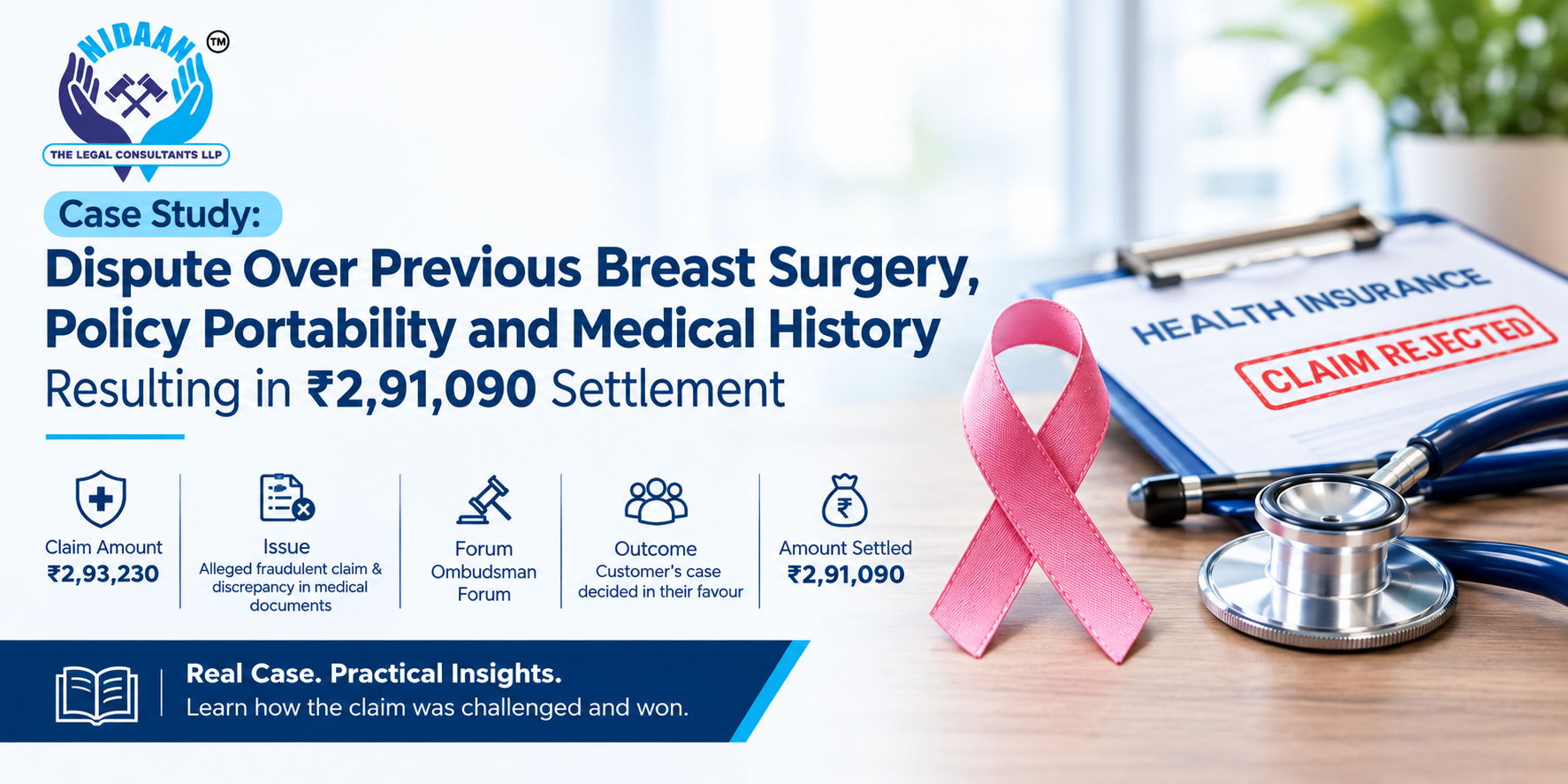
Case Study: Health Insurance Claim Dispute Involving Alleged Non-Disclosure of Previous Breast Disease
A health insurance claim can become complicated when an insurer alleges non-disclosure of a previous medical condition or questions the accuracy of medical records.
This case involved a health insurance claim of ₹2,93,230 that was rejected by the insurance company on the allegation of a fraudulent claim and discrepancy in medical documents relating to the duration of carcinoma breast.
After examining the customer’s medical history, insurance-related information and the circumstances surrounding the alleged non-disclosure, our team represented the customer’s case before the Ombudsman Forum.
The matter was ultimately decided in the customer’s favour, and ₹2,91,090 was settled.
Important: This case study describes a specific matter based on the documents and information provided for the case. The outcome of an insurance claim dispute depends on its individual facts, policy terms, medical records and applicable grievance-redressal mechanisms.
Case at a Glance
| Particular | Details |
|---|---|
| Category | Health Insurance |
| Claim Amount | ₹2,93,230 |
| Issue | Claim rejected alleging fraudulent claim and discrepancy in medical documents concerning duration of carcinoma breast |
| Forum | Ombudsman Forum |
| Outcome | Customer’s case decided in their favour |
| Amount Settled | ₹2,91,090 |
The original case study records the claim amount as ₹2,93,230 and the amount settled as ₹2,91,090.
Why Was the Health Insurance Claim Rejected?
The insurance company rejected the claim alleging:
“FRAUDULENT CLAIM – DISCREPANCY IN MEDICAL DOCUMENTS – DURATION OF CARCINOMA BREAST.”
The insurer’s position therefore centred on the alleged discrepancy regarding the duration of the breast condition and treated the matter as a fraudulent claim.
This made the patient’s previous medical history and the circumstances surrounding the disclosure of the condition particularly important to the dispute.
Our Review of the Customer’s Medical History
According to the information provided in the case, the patient had undergone breast surgery approximately 12 years earlier.
Following the surgery, the patient reportedly had no further problems relating to the condition and was not undergoing treatment for it.
The case documents further state that, when the insurance policy was ported and the company asked whether the patient had any old disease for which she was continuously undergoing treatment, the patient’s family disclosed that she was receiving treatment for hypertension and diabetes.
According to the case material, the previous breast condition was not disclosed because it had been treated approximately 12 years earlier, had completely healed, and the patient was not receiving treatment for it.
The Key Issue: Was the Previous Breast Surgery a Continuing Pre-Existing Disease?
The central issue raised in the customer’s clarification was whether a medical condition that had been treated approximately 12 years earlier, with no continuing treatment or reported problems thereafter, could be treated in the same manner as a continuously treated pre-existing disease.
The case representation argued that the breast condition had completely healed and that there had been no ongoing treatment for it.
The customer’s position was also that the medical condition was not deliberately concealed because it was an old, resolved condition and was no longer under treatment.
The Customer’s Position Regarding Medical Disclosure
According to the case documents, the patient had clearly disclosed ongoing treatment for hypertension and diabetes when responding to the insurer’s questions during policy portability.
The case representation argued that the old breast condition was materially different because:
- the surgery had taken place approximately 12 years earlier;
- the condition had subsequently healed;
- there was no continuing treatment for the breast condition;
- the patient was not experiencing continuing problems relating to that condition; and
- the patient’s ongoing medical conditions, including hypertension and diabetes, had been disclosed.
These points formed an important part of the customer’s representation against the allegation of concealment or fraudulent claim.
Our Approach to the Insurance Claim Dispute
Our team conducted a detailed review of the customer’s documents and the circumstances surrounding the claim rejection.
1. Examination of the Insurer’s Rejection
We reviewed the reason cited by the insurance company, particularly the allegation concerning a discrepancy in medical documents and the duration of carcinoma breast.
2. Review of Previous Medical History
The patient’s previous breast surgery and subsequent medical history were examined to understand whether the condition was continuing or whether it had been treated and resolved.
3. Review of Disclosure During Policy Portability
The customer’s disclosure of hypertension and diabetes during the portability process was considered as part of the overall factual background.
4. Clarification Regarding the Previous Breast Condition
The customer’s position was presented that the breast condition had been treated approximately 12 years earlier, had healed, and was not subject to continuing treatment.
5. Representation Before the Ombudsman
After reviewing the available information, our team represented the customer’s case before the Ombudsman Forum with supporting evidence and relevant regulatory considerations.
Moratorium Period Argument Raised in the Case
Another important issue raised in the representation concerned the moratorium period.
According to the case material, the customer’s policy had been running for a substantially long period. The case representation stated that the policy had been maintained for approximately 15 years and relied upon the applicable policy/regulatory provision concerning claims after the moratorium period.
The customer’s position was that, given the length of time for which the policy had been continuously maintained, the insurer’s rejection was inconsistent with the applicable policy terms and conditions.
Note: The exact regulatory provision, policy wording and applicable version of the IRDAI rules should be independently verified against the policy and the relevant period before this section is relied upon as legal advice.
Outcome of the Case
The representation resulted in a favourable outcome for the customer.
The Ombudsman Forum ruled in the customer’s favour, and ₹2,91,090 was settled against the original claim amount of ₹2,93,230.
The outcome demonstrates the importance of carefully examining an insurance claim rejection, particularly where the rejection involves allegations relating to previous medical conditions, medical-document discrepancies or alleged non-disclosure.
Key Takeaways for Health Insurance Policyholders
1. Understand the Exact Reason for Rejection
If an insurer rejects a claim by alleging non-disclosure, fraud or discrepancies in medical records, carefully review the exact basis of the rejection.
2. Maintain Your Medical Records
Keep records relating to previous surgeries, treatments, hospitalisations and medical consultations. These records may become important if questions arise regarding medical history.
3. Be Careful During Policy Portability
When porting a health insurance policy, policyholders should answer the insurer’s questions accurately and provide relevant information requested during the portability process.
4. Distinguish Between Previous and Continuing Medical Conditions
The medical history of a policyholder should be considered in its proper context. A previously treated condition and a condition requiring continuing treatment may raise different factual and policy questions.
5. Review the Policy’s Applicable Terms
Insurance policies contain specific terms and conditions concerning waiting periods, pre-existing diseases, disclosures and other matters. The applicable policy wording should always be examined before reaching a conclusion about a claim.
6. Consider Available Grievance-Redressal Mechanisms
If a policyholder believes that a claim has been wrongly rejected, the available grievance-redressal mechanisms may provide an avenue for further review.
Why Professional Review Can Make a Difference
Insurance claim disputes involving medical history can become complicated because they may involve:
- previous surgeries or illnesses;
- medical records created at different points in time;
- questions regarding disclosure;
- policy portability;
- allegations of non-disclosure or fraud;
- policy terms and conditions; and
- applicable regulatory or grievance-redressal provisions.
A detailed review can help bring these different aspects together and ensure that the customer’s position is presented clearly.
In this case, the customer’s medical history, disclosure during portability and long-running policy were among the matters considered in presenting the dispute before the Ombudsman Forum.
Frequently Asked Questions
Can a health insurance claim be rejected for non-disclosure of a previous medical condition?
An insurer may raise questions regarding previous medical conditions and disclosure depending on the policy terms and circumstances. However, each case must be examined based on the actual medical history, disclosures made, policy wording and applicable regulations.
What if a previous medical condition was treated many years ago?
A previous medical condition should be assessed based on the actual facts, including when it occurred, whether treatment continued, whether symptoms persisted and what was disclosed during the insurance application or portability process.
What should I do if my health insurance claim is rejected as fraudulent?
Obtain and carefully review the insurer’s rejection letter, collect the relevant policy and medical documents, and examine the basis on which the allegation has been made. Professional assistance may be appropriate depending on the circumstances.
Does health insurance portability affect medical disclosure?
Portability can involve disclosure and underwriting-related information. Policyholders should carefully respond to questions asked during the portability process and retain copies of the information provided.
What is the moratorium period in health insurance?
The moratorium period refers to a period after which certain restrictions concerning non-disclosure or misrepresentation may apply differently under the applicable health insurance regulations and policy terms. The exact rules depend on the relevant regulatory framework and policy version.
What was the outcome of this case?
In this case, the customer’s matter was decided in their favour before the Ombudsman Forum and ₹2,91,090 was settled against the original claim amount of ₹2,93,230.
Does this case guarantee that another rejected insurance claim will be successful?
No. Every insurance dispute is different. The outcome depends on the policy terms, medical evidence, documents, disclosures, facts of the case and the applicable grievance-redressal process.
Looking for Assistance With a Rejected Health Insurance Claim?
If your health insurance claim has been rejected because of alleged non-disclosure, pre-existing disease, medical-document discrepancies or other reasons, it may be useful to have the complete matter reviewed.
Nidaan assists customers in reviewing insurance claim disputes and presenting their cases through appropriate grievance-redressal mechanisms.
Contact Nidaan
Have you received a health insurance claim rejection?
Contact Nidaan to discuss your case and understand the possible next steps based on your policy documents and medical records.
Get Your Insurance Claim Reviewed →
About the Case Study Author
Dr. Ashish Dubey
General Manager – Medical
Dr. Ashish Dubey contributed the original case study and medical/health-insurance claims perspective underlying this matter.
The case study has been edited and structured by Nidaan – The Legal Consultant for website publication, readability and SEO, while retaining the substantive facts provided in the original case material.
Case Study Disclaimer
This case study is provided for informational purposes and is based on the facts and information supplied for the particular matter described above.
It does not constitute legal advice, insurance advice or a guarantee of a similar result in another case.
Every insurance claim dispute is different and depends on the applicable policy terms, medical records, disclosures, evidence, facts and grievance-redressal process.
The reference to regulatory provisions in this case study reflects the position presented in the original case material. The exact applicability of any regulation or policy clause should be independently verified against the relevant policy wording and regulatory framework before taking action.
Client-identifying information has not been included in this case study.
